
Skip a tax bill in April and nobody shows up at your door next month. The balance just sits, quietly picking up interest, until three years pass and the county treasurer is legally required to act. That long silence catches a lot of Washington homeowners off guard. Nothing happens for ages, and then a certificate gets filed in Superior Court. Property tax foreclosure in Washington crawls along and then moves fast. It’s run by the county treasurer, not by any bank or lender you’ve worked with.
I’ve bought houses across Washington for years. More than once I’ve sat at a table with owners holding notices they hadn’t opened in months. There are real ways out, and most of them show up earlier than people expect.
What Is a Delinquent Property Tax Account in Washington?
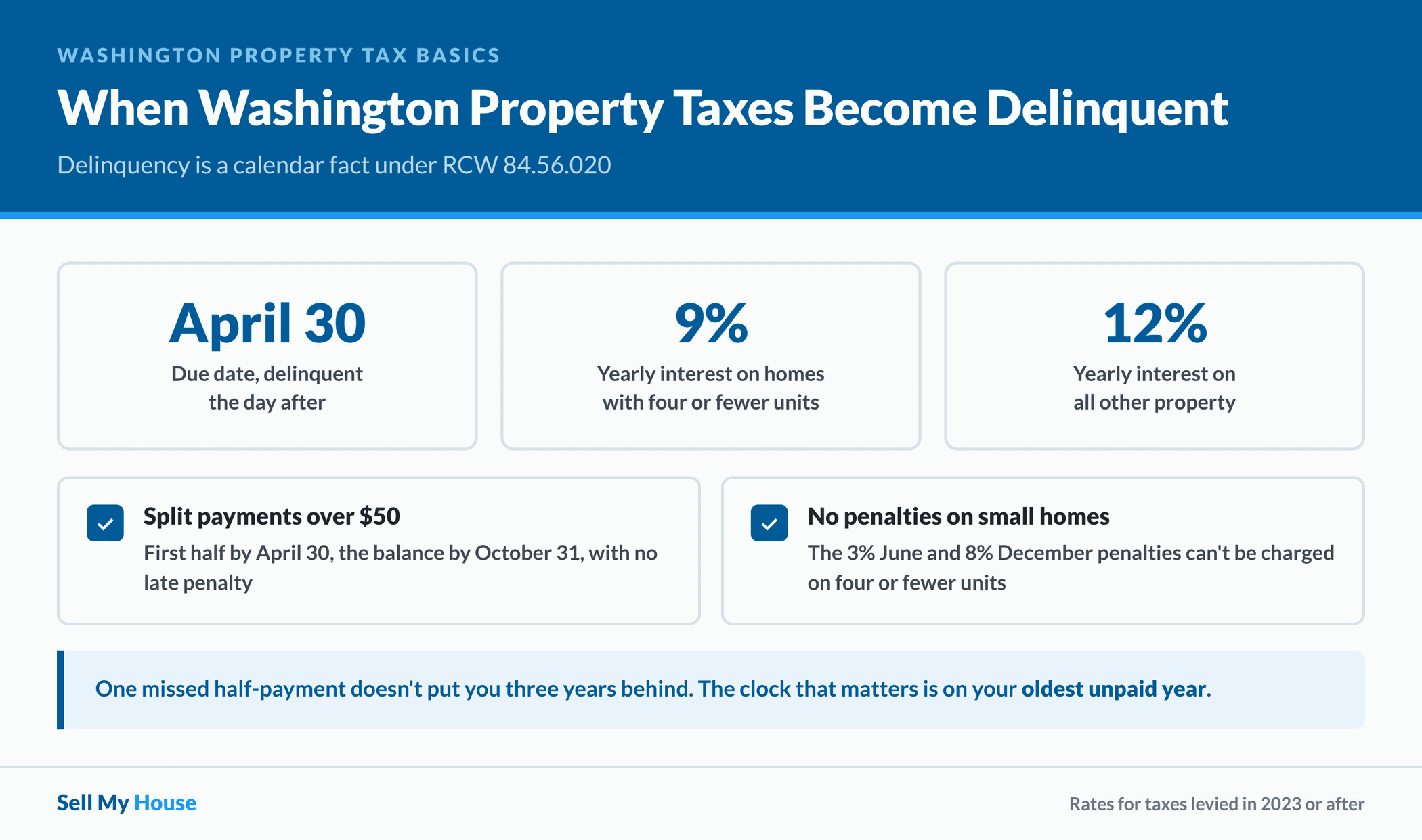
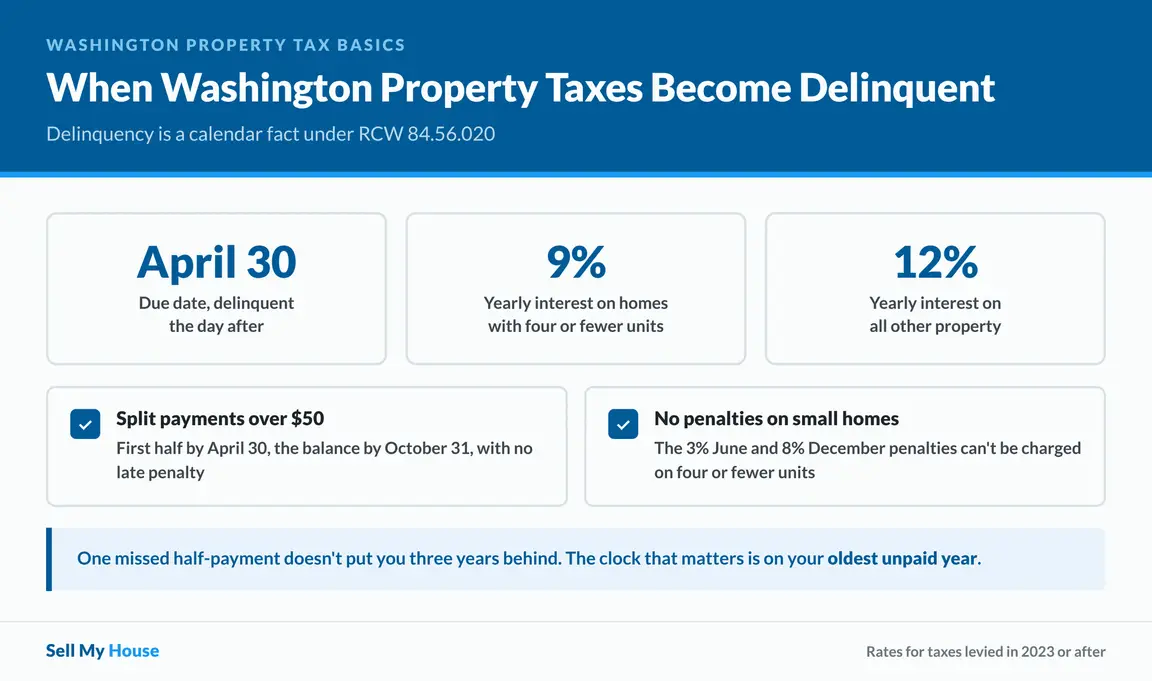
Lots of people hear “delinquent” and picture the county already coming after them. That’s not what it means. In Washington, delinquency is just a date on the calendar. Property taxes are due to the county treasurer on or before April 30, and under RCW 84.56.020 they’re delinquent the day after. If your bill tops $50, you can pay half by April 30 and the rest by October 31. Splitting it that way carries no late penalty.
Residential real property with four or fewer units, manufactured homes included, accrues interest at 9 percent per year on taxes levied in 2023 or later. Everything else pays 12 percent. Those smaller residential parcels also escape the 3 percent June and 8 percent December penalties that hit other property. A single-family home in Washington picks up interest only, while a five-unit building or a commercial parcel gets the penalties on top. Owners who assume every property is treated alike tend to miss that split.
People get tangled up on one point. A single missed half-payment doesn’t put you three years behind. The clock that matters starts on your oldest unpaid year.
Call your county treasurer’s office with your parcel number. They can pull your exact balance in about five minutes, and the call costs nothing. Ask which year your oldest unpaid tax comes from. Most owners I meet can’t answer that, yet everything after it hinges on that one date.
What Happens When Your Property Taxes Become Delinquent?
“The county won’t really take my house over a few thousand dollars.” I hear that in nearly every kitchen I sit in, and in Washington it isn’t true. The treasurer has no option to let it slide forever. After three years from the date of delinquency, the treasurer must issue a certificate of delinquency under RCW 84.64.050. Then the treasurer’s office, working with the prosecuting attorney, files it with the superior court.
Snohomish County describes its own timeline. Once real property is three years delinquent, the parcel is flagged as pre-foreclosure and a pre-foreclosure cost is added. Around mid-February, the taxpayer of record gets a special statement with notice. Leave the qualifying year unpaid past the end of April, and the parcel is subject to foreclosure starting May 1.
From there, foreclosure costs pile on top of the taxes, penalty and interest, growing monthly. A title search also gets run on each parcel, and the owner pays for it.
Say four annual bills of $4,000 each go unpaid on a Spokane bungalow. That’s $16,000 in base tax before you add a dime of interest, court costs or the title search fee. Think of it as the floor, not the total.
Few lenders will refinance a Washington property with a recorded certificate of delinquency on it. Closing a sale on a 30-day timeline gets tricky too, because the treasurer has to reissue the payoff figure.
Can You Set Up a Payment Plan for Delinquent Property Taxes?
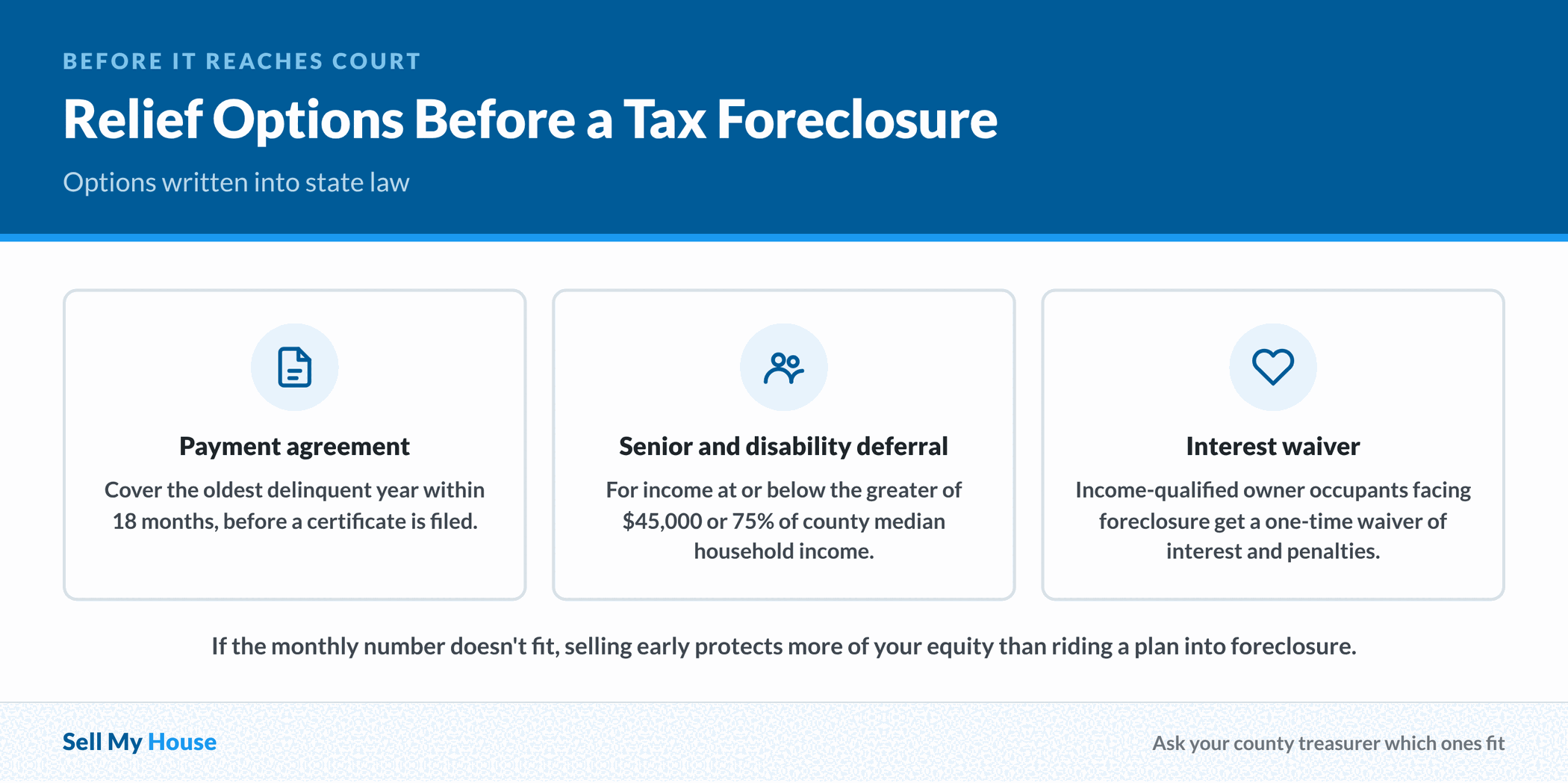
Washington does allow payment agreements. They’re written into the same statute that defines delinquency, so a taxpayer doesn’t have to wonder whether one is allowed. The treasurer may offer an agreement on past due delinquencies, signed by the taxpayer and the treasurer or a deputy. Partial payments toward current and delinquent taxes can be accepted separately, too.
Under an agreement, payments on past due taxes have to clear the oldest delinquent year, with its interest, penalties and taxes, within an 18-month period before a certificate of delinquency is filed. Your money goes to that oldest year first, which is the right order, since that’s the year pushing you toward property tax foreclosure.
Seniors and people with disabilities can look at the deferral program, which lets you postpone payment. The Washington State Department of Revenue pays the taxes for you, and you repay the state later. To qualify, your combined disposable income has to stay at or below your county’s threshold. That’s the greater of $45,000 or 75 percent of county median household income, and the Department of Revenue posts current figures on its property tax page.
One rule shields plenty of older Washington homeowners. An income-qualified owner occupant facing foreclosure gets a mandatory one-time waiver of outstanding interest and penalties. And the treasurer may not sell property that’s eligible for deferral.
Some sellers I’ve met signed agreements they couldn’t fund. They bought themselves nine months and reached the auction calendar with less equity than when they started. If the monthly number doesn’t work for your budget, selling early in Washington usually protects more of what you’ve built than riding a plan into property tax foreclosure.
How Does a Property Tax Foreclosure Work in Washington?
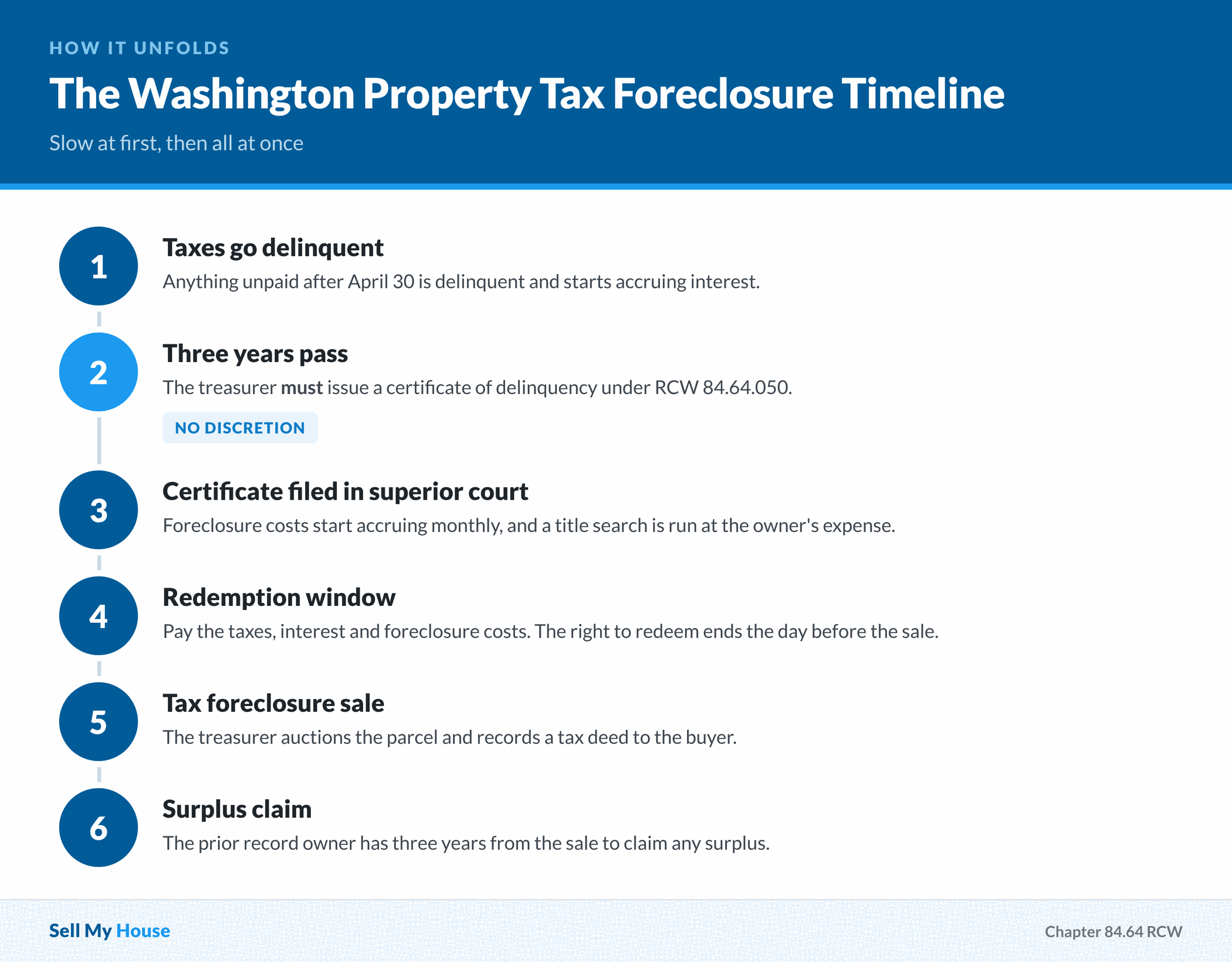
“So does the county just take it?” Not quite. A Washington county has to go through court first. Washington sells tax deeds, not liens, so counties foreclose in superior court after three years, and your right to redeem ends the day before the sale. Under RCW 84.64.050, the treasurer issues the certificate to the county on every delinquent parcel and files it with the clerk of the superior court. The treasurer and the prosecuting attorney then foreclose the lien in the county’s name.
I wish more Washington owners understood redemption. You can redeem any time before the tax foreclosure sale by paying the taxes, the interest and the accrued foreclosure costs. The treasurer adds up the costs of foreclosing the certificate, title search cost included, and folds them into the redemption amount. That total surprises a lot of owners. If you want the statutory language, the full chapter is posted at app.leg.wa.gov.
Snohomish County holds an annual delinquent tax foreclosure auction. Per the county, a parcel with a full year of 2023 or earlier taxes still unpaid as of January 2026 is eligible for its December 2026 sale.
Have a mortgage? Your servicer is probably watching. Most servicers in Washington monitor tax status and advance the payment, then bill you through escrow. That’s its own headache, though it isn’t a property tax foreclosure.
With the mortgage paid off, nobody steps in. No lender advances a dime, and the Washington property tax foreclosure track runs all the way to the end.
How Can You Avoid Property Tax Foreclosure in Washington?
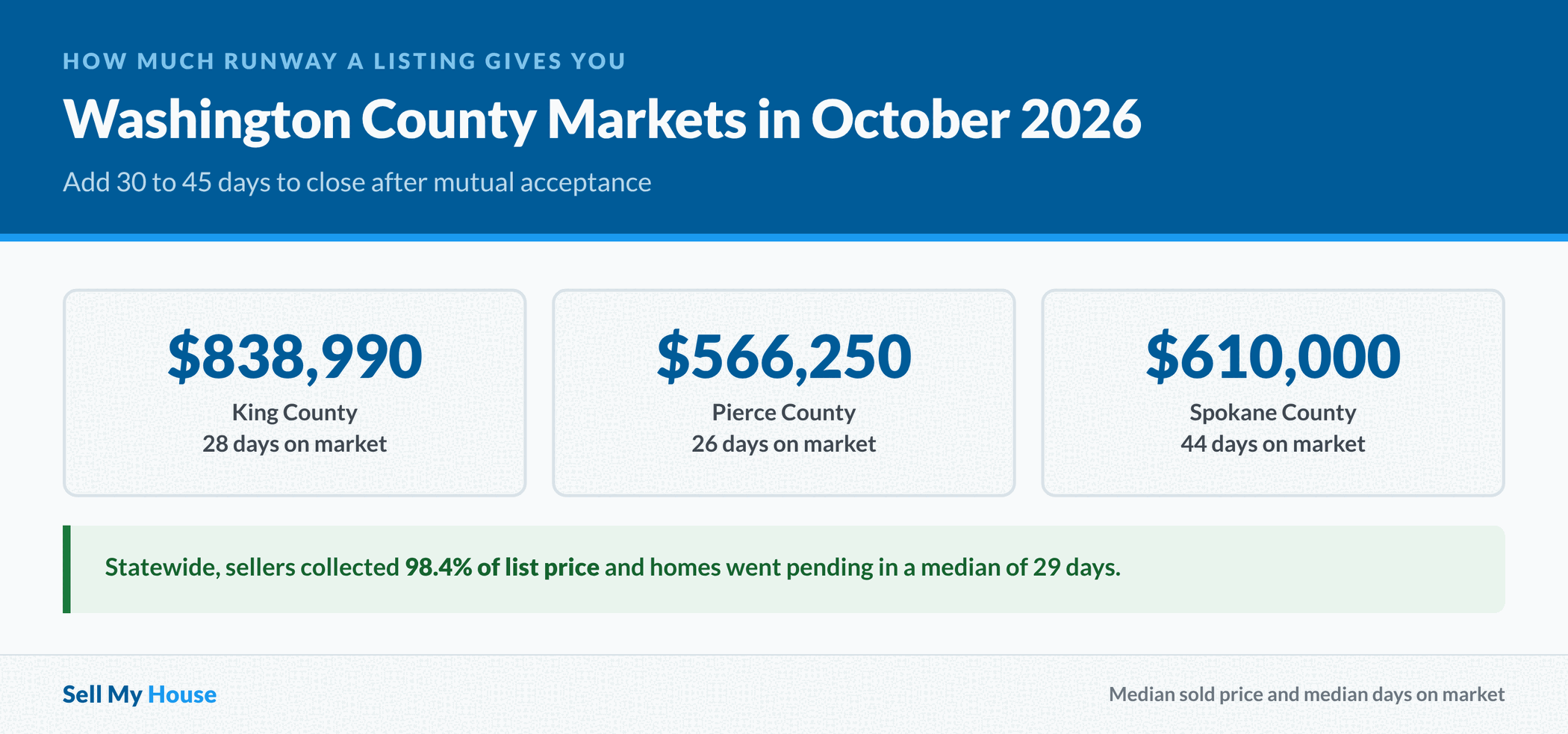
Selling is a perfectly legitimate way out, and it barely gets mentioned. A closing pays the treasurer directly out of escrow. As of early October 2026, Washington’s statewide median sold price over the trailing 12 months was $612,000. Homes went pending in a median of 29 days, and sellers got 98.4 percent of list price. Put that kind of equity next to a five-figure tax balance and the math isn’t close.
County numbers show how much runway a listing actually gives you. In October 2026, King County posted a median sold price of $838,990 with 28 median days on market. Pierce County came in at $566,250 with 26 median days. Then add 30 to 45 days to close after mutual acceptance. In those Washington markets, that’s roughly two to three months from yard sign to money at the treasurer’s window.
Eastern Washington moves slower. Spokane County showed a $610,000 median sold price in mid-October 2026, a 44-day median time on market, and a softer 96.6 percent sale-to-list ratio. A Spokane Valley or Hillyard house racing a spring auction deadline needs more lead time than a Ballard listing would.
A few other moves are worth making this week. If you’re 61 or older, apply with your county assessor for an exemption. Living in the home? Ask the treasurer about the interest waiver. You might also see whether a sibling or heir can cover the oldest year.
Some Washington houses just won’t list cleanly. Think deferred roofs, tenant damage, hoarding, or an estate where three heirs can’t agree. That’s where a direct sale earns its keep, and Sell My House buys in that condition without asking you to fix anything first.
So which fits your house, a listing or a direct sale? Be honest with yourself about that, and the rest of the decision gets easier.
What Happens If You Ignore a Property Tax Foreclosure Notice?
Open the envelope. It’s the most useful advice I can give a Washington homeowner, and it’s the step people skip most often.
Ignoring a property tax foreclosure notice doesn’t pause anything in Washington. The certificate is already on file, costs keep climbing monthly, and the auction date keeps getting closer. The treasurer then executes a tax deed that’s recorded like any other conveyance and vests title in the grantee. RCW 84.64.180 treats that deed as prima facie evidence of four things: the property was taxable, the taxes went unpaid, nobody redeemed, and the sale followed the law.
Losing the deed doesn’t always mean losing every dollar. When a parcel sells for more than what’s owed, the previous record title owner can claim the surplus. That’s whoever held title on the day the certificate of delinquency was filed. The claim has to be made within three years of the sale date. Miss that window and the money moves to the county current expense fund for good.
I keep seeing the same thing in Washington. The owner who ignores the notice usually isn’t lazy. They’re overwhelmed, sometimes grieving, and often handling a house two hours away from where they live now. Honestly, shame does more damage than the interest rate.
Spend ten minutes with your treasurer’s delinquency desk. It’ll do more for you than another month of avoiding the subject.
Can You Appeal a Property Tax Foreclosure in Washington?
Beating a Washington property tax foreclosure on the merits is hard. The foreclosure runs through superior court, and the judgment carries real weight because it estops prior parties from raising objections that existed at or before it. In plain terms, arguments you could have made before judgment usually don’t survive after it.
Your window is the stretch after the certificate gets filed in your county’s superior court and you’re served. That’s when a defense still means something. Maybe there’s a payment error, a wrong parcel, a service problem, or an owner who qualifies for deferral that the treasurer must honor. Raise it then, in writing, and bring a lawyer if you can. The Northwest Justice Project and county bar associations across Washington take these calls.
Think your Washington home is over-assessed? Take that argument to your county board of equalization long before any delinquency shows up. The Department of Revenue walks through the process on its appeals page. Arguing value after a certificate is filed won’t stop a sale.
Minors and people who are legally incompetent get a longer runway. They may redeem a parcel within three years of the foreclosure sale by paying the sale amount plus interest and penalty on the tax. The prior owner also reimburses the new owner for any improvements. It’s a narrow exception, so don’t count on it as a backup plan.
My honest read is that appeals rarely save Washington homes from property tax foreclosure. Sales, payment plans and deferrals do. Put your energy where the odds are.
What Happens at a Property Tax Foreclosure Sale in Washington?
Each county sets its own sale date. Pierce, King and Whatcom County up near Bellingham all run separate schedules. Most Washington counties post the parcel list on the treasurer’s website weeks ahead, and plenty now take bids online.
Bidders end up paying more than the opening number suggests. RCW 84.64.200 requires every bidder except the county to pay all taxes, interest and costs delinquent at the time of sale, even ones the judgment left out. So a parcel with a modest judgment amount can still draw cautious bidding at a Washington tax sale.
Investors price that risk in. That’s a big reason auction proceeds so often land below what the same Washington house would bring on the open market.
In October 2026, Washington’s median active listing price sat at $649,900, against a $615,000 median sold price over the preceding period. Thurston County, around Olympia and Lacey, posted a $513,000 median sold price that month with 29 median days on market. You won’t get numbers like that at an auction.
A landlord in Kent called me after almost a year of quietly covering two mortgages. One was on his own place. The other was a rental he couldn’t fill after a bad tenant left the basement in rough shape. He’d stopped paying the taxes on the rental to keep his primary current, and that’s how a lot of Washington property tax foreclosure cases really start. We closed on a Tuesday, and he got to keep the shop tools from the garage.
If that sounds familiar, Sell My House will look at a Washington property in any condition. You’ll get a straight number to hold up against your treasurer’s payoff figure.
Frequently Asked Questions
Do Washington Homeowners Actually Pay Property Taxes?
Yes. Washington has no state income tax, so property tax carries a big share of the load for schools, roads, fire districts and county services. Every owner of real property in Washington gets an annual bill from the county treasurer. No general homestead exemption wipes it out. Seniors, people with disabilities and some veterans can get targeted relief, though you have to apply for it through your county assessor.
Is a Tax Deed the Same Thing as a Foreclosure?
They’re related, but they aren’t the same thing. The foreclosure is the court process the county runs to cut off your ownership interest. The tax deed is the document issued afterward, transferring title to whoever bought the parcel. Because Washington is a deed state rather than a lien state, no third party can buy your tax debt and charge you interest on it. In practice the county forecloses, then the treasurer holds the auction and issues the deed.
What Are the Main Foreclosure Laws in Washington State?
Two bodies of law matter, and they work differently. Chapter 84.64 RCW governs property tax foreclosure through the county treasurer and superior court. Mortgage foreclosure in Washington usually runs as a nonjudicial trustee sale under the deed of trust act. A property tax foreclosure wipes out most junior interests, which is why lenders track tax status closely and often advance payment to protect themselves. If both are moving on the same Washington property, talk to an attorney, since the timelines don’t line up.
How Does a Foreclosure Affect My Income Taxes?
For federal tax purposes, a completed foreclosure is treated as a sale. Gain or loss gets calculated, and forgiven debt can sometimes count as income. Washington owners of a primary residence can often shelter the gain under the federal exclusion for a home you’ve owned and lived in. Investment property doesn’t get that break. Surplus proceeds claimed after a tax sale may carry tax consequences too, so run the numbers with a CPA before assuming the IRS won’t care.
Can I Sell My House After a Certificate of Delinquency Is Filed?
You can, right up until the sale. Washington title companies handle delinquent tax payoffs all the time. The treasurer provides a figure, and escrow wires it at closing. Timing is the hard part, because the payoff grows monthly and auction dates don’t budge. Start early enough that a buyer’s financing or a cash closing can land before your county’s sale date.
Staring at a tax notice and unsure whether to fight it, finance it or sell? I’m happy to walk through the math with you. There’s no pressure, and if keeping the house is the smarter move, I’ll tell you so.
Tax Debt and the Seattle Market
According to Redfin, Seattle sale prices dipped 5.1% from a year earlier in the four weeks ending October 25, 2026.
A softer market can drag a listing out while the treasurer’s payoff grows every month. When you do sell, the tax balance comes straight out of escrow at closing. That makes your timing as important as your price.
Ask Us About Your Tax Notice
Carrying a certificate of delinquency is a lot, and you don’t have to sort it out alone. We’ll go over the numbers with you and make a cash offer you can compare against your treasurer’s payoff.
Contact us with a few details about the property, or use the form below. It costs nothing, and you’re under no obligation to sell.
Helpful Washington Blog Articles
- Can A Buyer Back Out After A Home Inspection In Washington
- How to Find a Realtor in Another State
- How Long Should You Live in a House Before Selling It
- Can You Sell a House With Asbestos in Washington
- How to Sell a House While Living in It
- Can Medical Bills Take Your House in Washington
- Cheapest Places to Live in Washington
- Property Tax Foreclosure in Washington