
A piece of paper that costs maybe forty dollars to file can hand away half of a $400,000 house. That’s the odd math of a property deed. One signature, one notary stamp and one trip to the county office, and a home’s ownership changes for good. A deed is the single most powerful document most families will ever sign, yet plenty of folks I’ve met signed one without reading past the names.
So do you need a lawyer? Not always. The answer swings hard depending on what you’re trying to do, and I’ve watched that difference cost people real money.
What Is a House Deed and Why Does It Matter?
Redfin’s national housing market data put the typical American home sale at $388,634 in October 2026. That’s the asset sitting behind your deed.
Think of it as the written instrument that transfers ownership of real property from one person to another. It isn’t your mortgage, and it isn’t your tax bill. The document names the grantor (the person giving up an interest) and the grantee (the person receiving it). It describes the property with a legal description, then gets signed and recorded in the public record. Title is the idea of ownership, and this paper is what moves it.
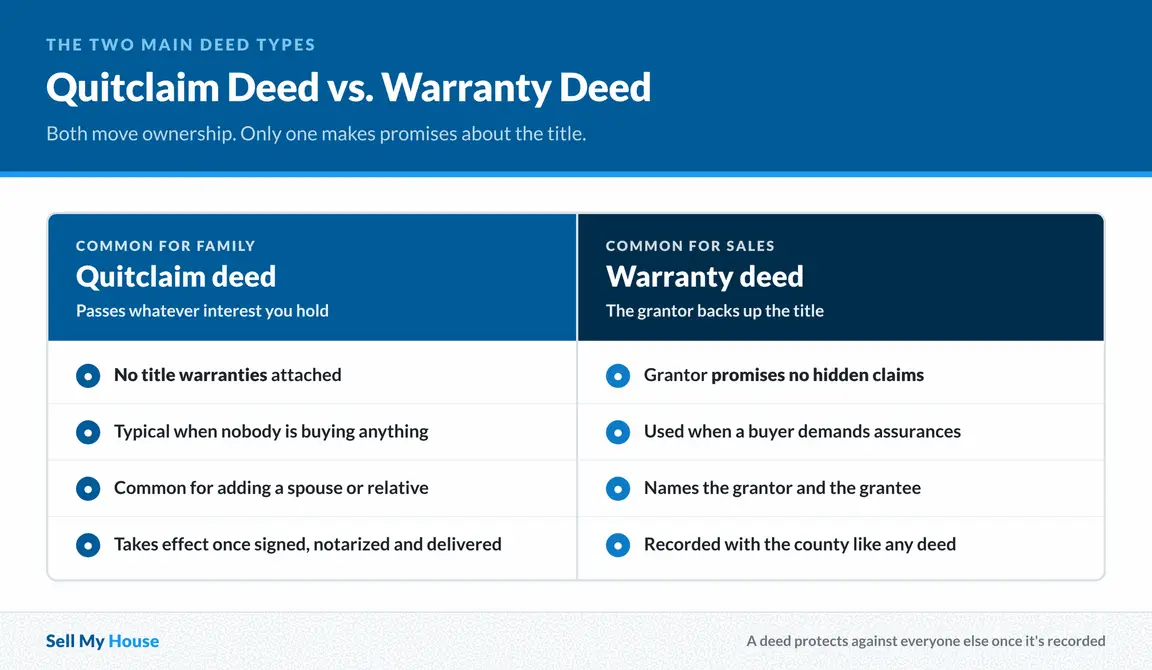
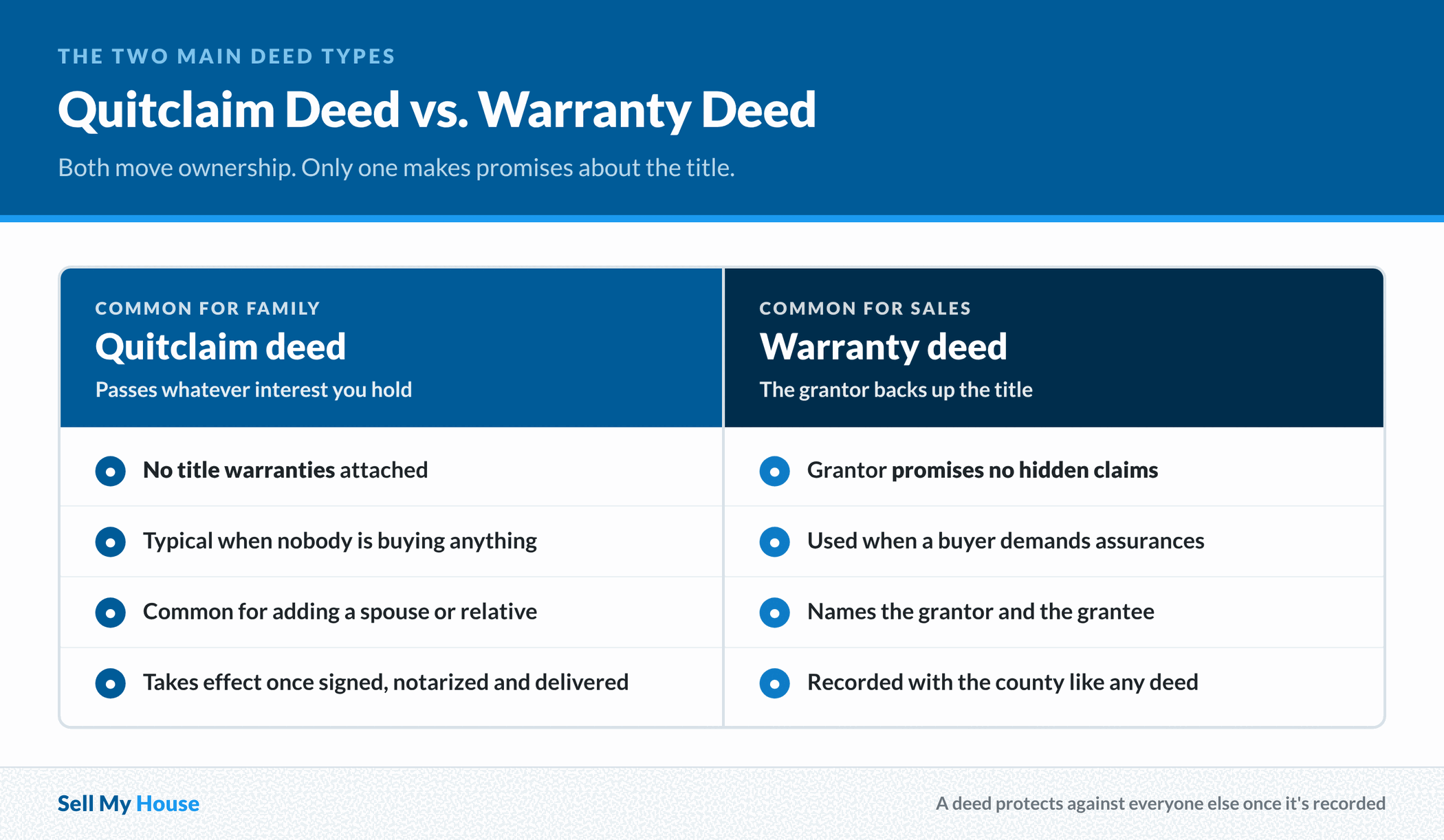
Homeowners mostly run into two kinds. A quitclaim transfers whatever property interest the grantor holds to the grantee, with no title warranties attached. A warranty version does the opposite, because the grantor backs the title with promises that no hidden claims exist. Family transfers usually use a quitclaim transfer, since nobody’s buying anything and nobody wants warranties on that interest.
Recording is what makes the deed public. Between the parties, a quitclaim deed takes legal effect once it’s signed, notarized and delivered to the grantee. It won’t protect the grantee against the rest of the world until it’s recorded with the county recorder or land records office where the property sits.
A couple of years ago, the adult kids of an elderly homeowner called me on a Tuesday. One had a job transfer, and they had five weeks to empty their mother’s house. Nobody in the family could find the original deed, and the back bedroom was still full of her sewing machines. We sorted out the paperwork through the county and closed with time to spare.
Can You Add Your Spouse to a Deed Without a Lawyer?
In most states, yes. The people telling you otherwise usually sell legal services.
Most states let a homeowner record a quitclaim without an attorney. The deed still has to follow county and state formatting rules, carry the right transfer tax statement, use the correct legal description and meet any witness requirements. California, for example, doesn’t require an attorney to prepare one. Per this state-specific guide, what matters there is the correct statutory language, an accurate legal description, proper notarization and recording with the County Recorder.
Florida and Georgia want witnesses as well as a notary. A handful of states go further and treat deed preparation as the practice of law. One free phone call to your county recorder will tell you which camp you’re in.
What about your mortgage? Adding a spouse to the deed doesn’t add them to the loan. Whoever signed the note still owes it alone. The federal Garn-St Germain Act also helps here, since adding a spouse to title, usually after a marriage, won’t trigger the due-on-sale clause.
I’ve had a lot of kitchen-table conversations about this. The paperwork usually isn’t the risky part of a spousal deed transfer. The risk is that people add a name without thinking about what happens if the marriage ends or one spouse brings creditors along. A lawyer earns their fee in that conversation, and typing up the form is the easy bit.
How Do You Add a Name to a Deed?
Get the legal description wrong and your deed can get kicked back. Or worse, it records anyway and clouds the title for years. This is the step worth slowing down for.
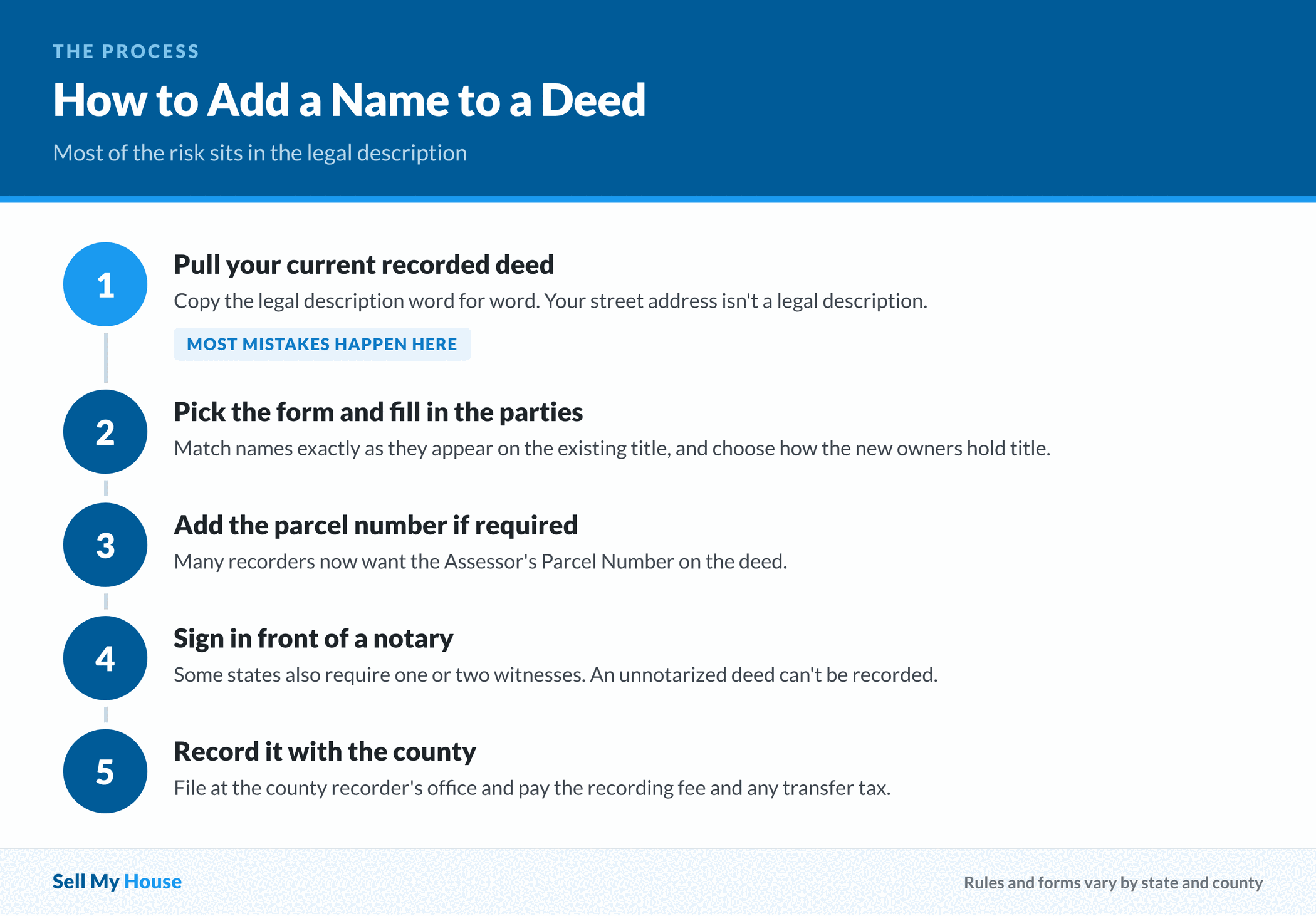
Start with your current recorded deed. Copy its legal description word for word, including lot numbers and metes and bounds. Your street address isn’t a legal description.
Next, choose your deed form and fill in the parties exactly as they appear on the existing title. A correct quitclaim deed comes down to five things. You need the grantor’s name as it appears on the existing title, plus the exact legal description from the current deed. You also need proper notarization (with witnesses where required), any supplemental state forms, and recording with the county recorder’s office. Then decide how the new owners will hold title. Your choices are joint tenants with right of survivorship, tenants in common, or tenancy by the entirety where the state allows it for married couples. That pick decides who inherits automatically and who doesn’t.
Signing comes next. The grantor signs in front of a notary public, which is what makes the deed recordable. Some states also want one or two witnesses. Skip the notary and the deed can’t be recorded at all.
Most state deed forms have a field for the Assessor’s Parcel Number. That’s the number the county tax assessor uses to identify the property, and many recorders now require it, according to this step-by-step walkthrough.
The last step is to record it. You file the signed deed at the county recorder’s office where the property sits and pay the recording fee, plus any documentary transfer tax, at the window.
How Do You Change a Name on a Deed After Marriage or Divorce?
“My last name changed when I got married. Does that make my deed wrong?”
No, your deed is still valid. The property belongs to the person who signed it, whatever that person’s name is today, and a marriage certificate links the old name to the new one. Plenty of homeowners go decades with a maiden name on the deed. It only comes up when they sell, and even then the title company just asks for a name affidavit.
Divorce is a different story. Even when a decree awards the house to one spouse, somebody still has to sign a deed conveying the other spouse’s interest. A judge can order that deed but won’t execute it. Until the transfer is signed and recorded, the ex-spouse stays on title with real ownership rights.
People get burned on this next point. Signing off the deed does nothing to the mortgage. If both names are on the home loan, both stay liable until it’s refinanced or paid off. I’ve met sellers who gave up the house in a divorce years ago and still had that mortgage dragging down their credit.
The transfer itself usually won’t let the lender call the loan. If you transfer your interest to a soon-to-be ex because of a dissolution of marriage, a legal separation or an incidental property settlement agreement, the due-on-sale clause can’t be enforced.
Sometimes a divorce leaves neither person able to carry the payment. Selling outright can be cleaner than refinancing then, since untangling the debt quickly matters more than keeping the house. Sell My House hears about that situation all the time: two people who need the deed and the debt sorted out together, and fast.
What Taxes Apply When You Add a Name to a Deed?
Put your kid on the deed and you’ve made a gift, which the IRS counts like any other.
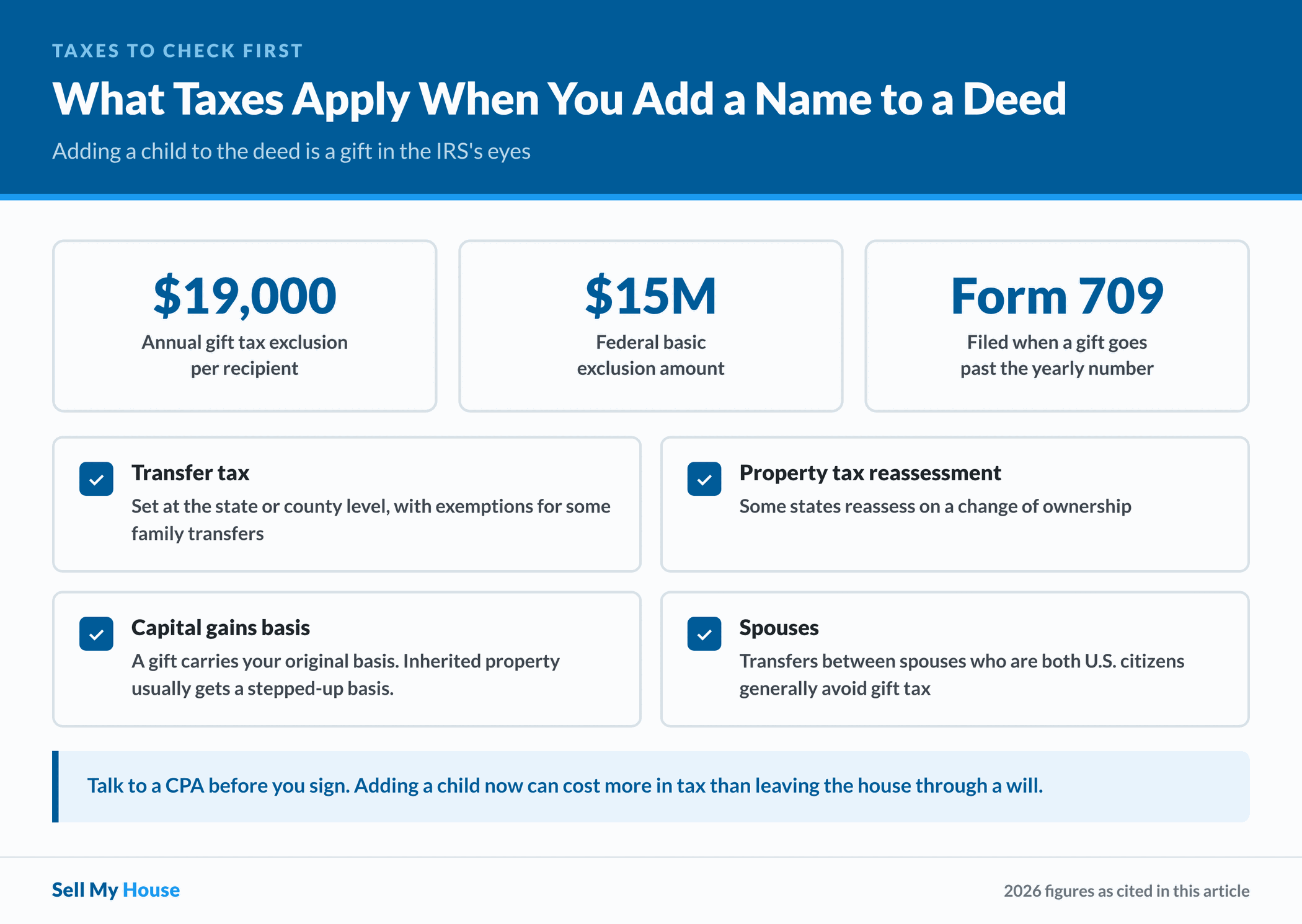
For 2026, the annual gift tax exclusion sits at $19,000 per recipient, and the federal basic exclusion amount is $15 million. Give your daughter half of a house and that half’s value is a gift. Go past the yearly number and you’ll file Form 709. Going over doesn’t create a tax bill by itself. It just triggers the Form 709 filing, and the excess comes off your lifetime exclusion. Transfers between spouses who are both U.S. citizens generally skip all of this.
Then there’s transfer tax at the county level, and the rates and exemptions vary wildly by state. California charges documentary transfer tax, though gifts are sometimes exempt. Florida applies documentary stamp tax based on consideration. Michigan layers a state transfer tax on top of a county tax, with exemptions for certain family transfers. Ask your recorder’s office for the current schedule before you file.
Check property taxes too. Some states reassess when ownership changes, while others carve out family transfers. A quick call to the assessor can spare you a nasty surprise on next year’s bill.
The item people skip is capital gains basis. A gifted interest usually carries your original cost basis over to the recipient, while inherited property typically gets a stepped-up basis at death. NAR’s third-quarter 2026 report put the national median single-family price at $432,900, up 1.7% year over year. For homeowners who’ve held a place for decades, a lot of appreciation can ride on that basis question. Adding a child to the deed now, rather than letting them inherit, can hand them a tax bill that a will would’ve avoided. Talk to a CPA before you sign.
What Are the Risks of Adding a Name to a Deed?
One widow put her son on the deed so the house would pass easily. Two years later his contracting business failed, and suddenly his creditors had a claim against her home.
That’s the core danger. Once a name lands on the deed, that person’s problems can attach to your property. Think judgments, liens, tax debts, a bankruptcy or a divorcing spouse with a marital interest. Undoing it isn’t quiet or easy. Removing someone from a deed takes their signature, and people who’ve just been handed half a house don’t always want to give it back.
A quitclaim can also wreck your Medicaid eligibility later on. Transferring an interest in your home may be treated as an uncompensated transfer, which can affect long-term care benefits. Rules differ by state, and the lookback analysis gets complicated fast. An elder law attorney earns their fee here.
Selling or refinancing gets harder as well. Every person on the deed has to sign the new deed or the new loan papers. Will all of them cooperate five years from now? Will you even be able to reach them?
A quitclaim deed carries no warranties, either. The recipient takes on whatever title problems already existed, right along with the gift.
Everyone on the title holds ownership rights in the property, full stop. That’s what the document is for.
What Happens to a Deed When There Is No Will?
When the property is held jointly with right of survivorship, nobody has to sign anything for the deed to pass at death. In that setup, survivorship beats the will, beats intestacy, beats everything. The surviving owner records a death certificate and an affidavit, and the deed catches up with reality.
With no survivorship and no will, state intestacy law decides. Each state has its own ladder, usually spouse first, then children, then parents, then siblings, in shares the statute fixes. The house doesn’t go to whoever lived there or paid the taxes. It goes where the statute says, which often means four siblings owning undivided interests in one property nobody can sell alone.
Probate is how that title gets cleaned up. A court appoints an administrator, the estate pays its debts, and the court authorizes a deed to the heirs. Depending on the state and whether the heirs get along, that can take a few months or well over a year.
A death transfer doesn’t let the lender accelerate the loan, either. If one spouse dies and the survivor becomes sole owner, the lender may not enforce a due-on-sale provision. The same goes when real property passes by inheritance after the borrower’s death.
Per this market summary, pending home sales dropped 7.3% in September 2026 and sat 11.3% below the prior year’s level. Heirs holding a vacant house in a slower market still owe insurance, taxes and upkeep for every month probate drags on. Some families who want out sooner call Sell My House once the court clears the deed.
When Should You Hire a Lawyer for a Deed Transfer?
Years ago I figured a quitclaim deed was a quitclaim deed. The only question, I thought, was whether somebody filled out the form right.
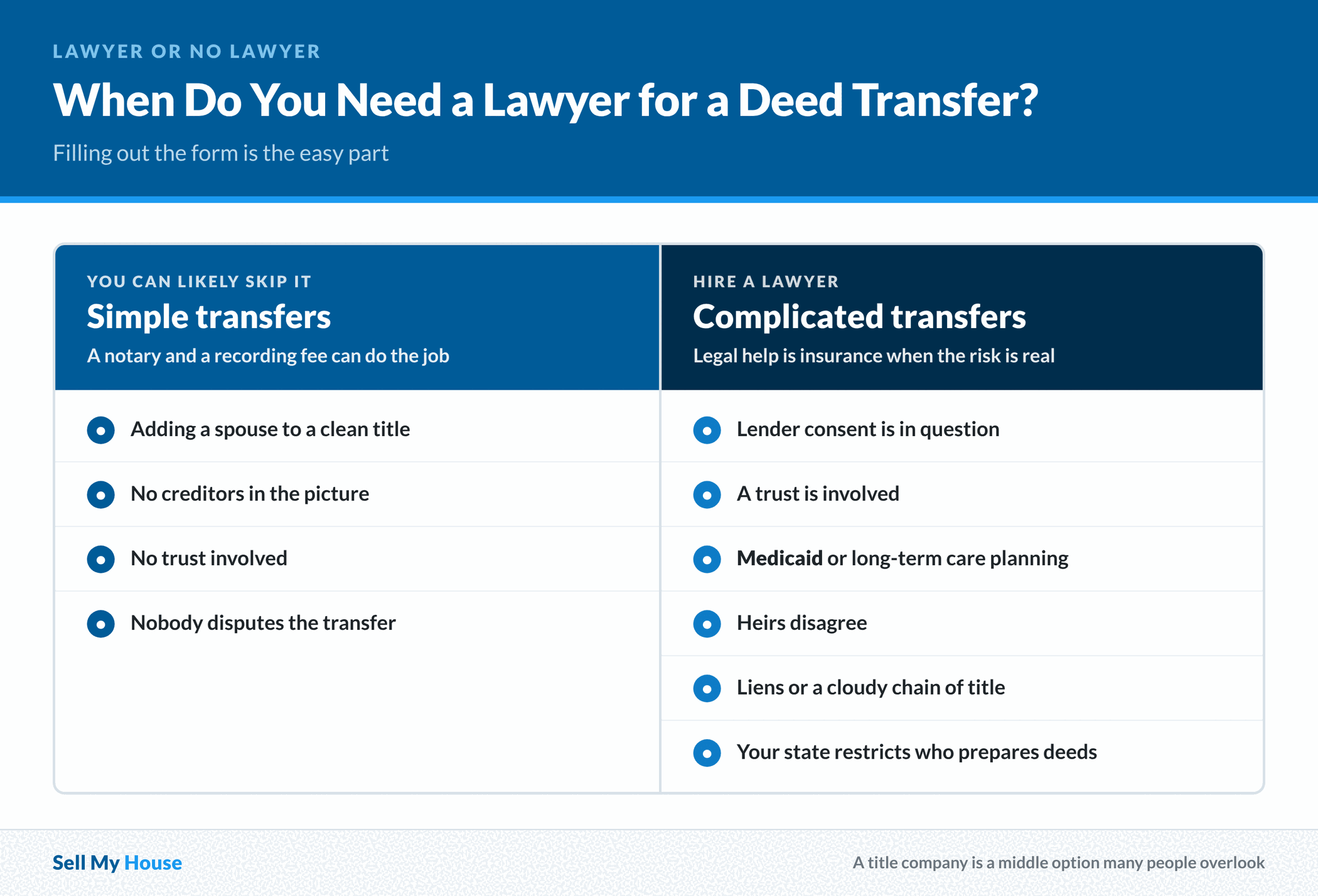
I had it backwards. The paperwork is easy. The real question is whether the transfer should happen at all, in that shape, with those consequences. Bring in a lawyer when a mortgage lender’s consent is genuinely in doubt, when a trust is involved, or when Medicaid or long-term care planning is on the table. Do the same when heirs disagree, when there are liens or a cloudy chain of title, or when the property sits in a state that restricts who may prepare a deed.
Skipping the lawyer is reasonable when you’re adding a spouse to a clean title with no creditors, no trust and no disputes. A notary, a recording fee and a careful read of your county’s formatting rules will handle it. Legal help is insurance, so buy it when the risk is real.
Plenty of people overlook the middle option, a title company. For a modest fee they’ll prepare and record the deed, and they’ll catch a bad legal description before the recorder does.
A landlord and his two siblings once inherited a duplex from an aunt who’d kept every newspaper since the Carter administration. All three wanted a clean exit. None of them wanted to spend a Saturday in that garage, which still held a boat trailer and about nine hundred mason jars. So we bought it as it stood, and they split the proceeds instead of the chore list.
Frequently Asked Questions
Does It Cost Anything to Add Someone to a Deed?
Yes, though it’s usually less than people fear. Expect a county recording fee, a notary fee, and possibly a documentary transfer tax, depending on your state’s rules and whether family transfers are exempt. Hiring an attorney or a title company to prepare the deed adds their charge on top. The tax consequences covered above tend to cost far more than the filing.
Which Matters More, the Deed or the Mortgage?
Neither wins, because they answer different questions. The deed says who owns the property, and the mortgage says who owes the money. You can be on the deed with no debt, or on the loan with no ownership, and both happen more than you’d think. Protecting yourself in a divorce or a family transfer means handling each document separately.
Does a Lawyer Have to Draw Up a Deed?
In most states, no. Homeowners prepare and record their own deed every day with state-specific forms, a notary and their county recorder’s instructions. A few states limit deed preparation to licensed attorneys, so check with your recorder’s office first. Even where a lawyer is optional, one is worth hiring once liens, trusts, benefit eligibility or a family disagreement enters the picture.
Can I Remove Someone From a Deed Without Their Permission?
Generally, no. A recorded ownership interest belongs to the person who holds it. Taking that interest back requires their signature on a new deed, or a court order. When someone won’t cooperate, the usual routes are a divorce decree or a partition action. That’s why the time to think hard is before you add a name.
Will Adding a Name to the Deed Affect My Homeowners Insurance?
It can. Insurers generally want everyone with an ownership interest named on the policy, and a new owner who isn’t listed may have no coverage for their share. Call your agent after recording and get the policy updated. Check your title insurance too, since it protects the owners named in it rather than any new ones.
Maybe your deed question started because the house has become more than you want to manage. We’re glad to talk it through. You might keep it or sell, or you might just want someone to explain how the pieces fit before you sign anything. Reach out to Sell My House whenever you’re ready. There’s no pressure and no hard sell, even if the answer turns out to be “hold onto it.”
Deed Changes and the Seattle Market
Most of these questions surface when something shifts in the family. A wedding, a divorce or an inheritance can suddenly put the house on the table.
At the end of August 2026, Zillow put the typical Seattle home value at $833,192, down 1.6% from a year earlier. That’s a lot of value riding on one document, so the paperwork deserves care.
If you’d rather sell than untangle a shared title, we buy inherited homes as they sit. South of the city, owners can work with our cash home buyers in Tacoma. Families in eastern Washington can sell a house in Spokane to us the same way.
Talk With Us About Your Deed Question
Changes like this often come with a bigger decision about the house, and we’re happy to walk through it with you.
Contact Sell My House with your question, or tell us about the property using the form below. It’s free, and you’re under no obligation to sell.
Helpful Washington Blog Articles
- Can A Buyer Back Out After A Home Inspection In Washington
- How to Find a Realtor in Another State
- How Long Should You Live in a House Before Selling It
- Can You Sell a House With Asbestos in Washington
- How to Sell a House While Living in It
- Can Medical Bills Take Your House in Washington
- Cheapest Places to Live in Washington