
A termite colony eats wood around the clock, and it does the job quietly. Termites work from the inside out, where nobody notices until a baseboard crumbles under a thumb or a floor joist gives a little as you cross the hall. That’s the part that rattles sellers. By the time you find out, the house may have been feeding a colony for years.
Maybe a pest control tech just gave you the bad news, and now you’re wondering if your sale is dead. It isn’t.
Can You Sell a House with Termites?
For years I told sellers to treat first and list later, every single time. That advice was too simple. I’ve since watched it cost people money they never needed to spend.
You can absolutely sell a house with termites. No law anywhere in the country stops you. Houses with active infestations change hands all the time, and so do houses with old damage repaired a decade ago. What changes is who shows up to buy it, and with that your timeline and your net at closing.
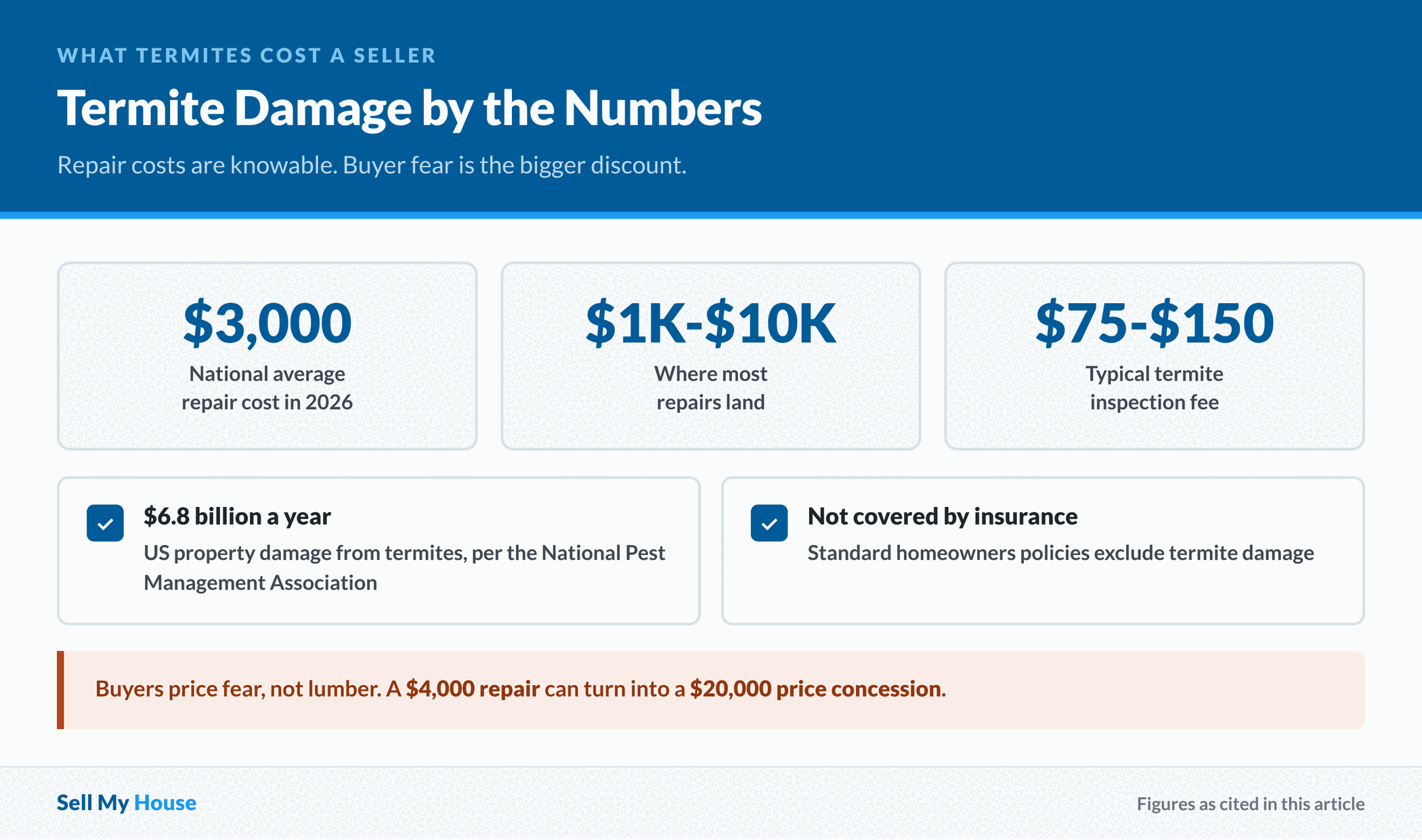
Termites show up all over the country. The National Pest Management Association says these insects cause more than $6.8 billion in US property damage every year, and homeowners insurance doesn’t cover it. Roughly 600,000 homes get hit annually. Your house isn’t unusual, just unlucky.
Most sellers underestimate timing, so it helps to look at the wider market. In September 2026, homes took a median of 33 days to go from listing to contract, with 4.8 months of supply on the market. Buyers have breathing room right now. Higher inventory and longer selling times in this market are nudging sellers toward price cuts, and a house with a known pest issue feels that squeeze twice.
A while back a longtime landlord called me about a rental he’d inherited from his father. The place held thirty years of belongings, and mud tubes ran up two piers in the crawlspace. His siblings wanted a clean exit before the holidays. We bought it on a Thursday with the garage still full of fishing gear and paint cans, and nobody had to sort a thing.
Active Termite Infestation Vs. Past Termite Damage: What’s the Difference?
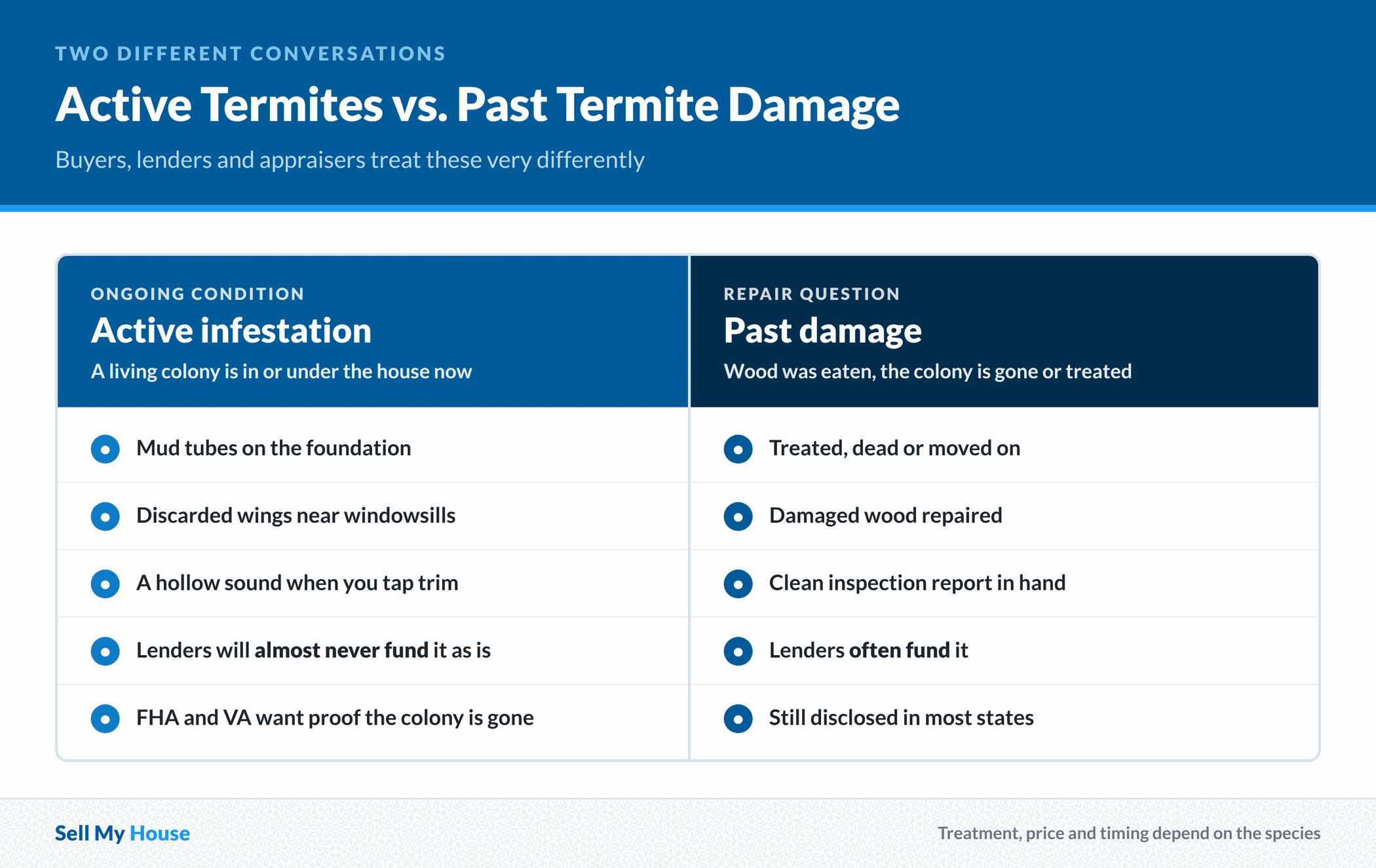
Sellers tend to treat these as one conversation, just two versions of the same bad news. A buyer, a lender or an appraiser sees them very differently.
Active termites means a living colony is in or under your structure right now. The signs include mud tubes on the foundation, discarded wings near windowsills, and trim that sounds hollow when you tap it. Past damage means wood got eaten at some point and the colony is gone, whether it was treated, died or moved on. The first is an ongoing condition. The second is a repair question.
Financing is why the difference matters. A lender will almost never fund a house with an active colony crawling through the framing. That same lender will often fund a house with repaired damage and a clean inspection report. FHA and VA loans in particular want proof, before closing, that active termites are gone and damaged wood has been fixed.
Subterranean termites cause most US damage, and they travel through soil, which is why they turn up in crawlspaces and slab cracks. Drywood termites live inside the wood and never need soil contact. Which species you have shapes the treatment, the price tag and how long remediation takes.
I see one pattern over and over in houses I walk. There’s fresh paint on the interior trim of an otherwise dated home. Usually the paint is innocent. Once in a while, though, someone filled and painted over termite galleries hoping nobody would look, and buyers’ inspectors always look.
Should You Get a Termite Inspection Before Selling?
Cost isn’t the obstacle. An annual termite inspection runs somewhere between $75 and $150, and plenty of pest control companies waive the fee if you’re also getting a treatment estimate. That’s a rounding error against your sale price. I’d order one on any house older than twenty years, even if you’ve never spotted a single bug.
It’s better to know. Sellers who skip the pre-listing pest inspection tend to hear about the termites on day 34 of escrow. A buyer’s inspector calls it out, and the buyer’s agent turns it into a renegotiation. Your leverage disappears the moment someone else’s report tells you something about your own house.
I part ways with a lot of agents on this. Plenty of them say never to order a termite inspection before listing, since once you know, you have to disclose. That logic is backwards, and it puts sellers at legal risk. Deliberate ignorance won’t protect you when a buyer’s inspectors find obvious mud tubes you walked past every day for ten years.
Get a written report with photos from the inspector, and ask whether the activity is current or historic. A good pest control report keeps those termites separate. That single page turns into your most useful negotiating document later on.
Try arguing a $15,000 repair credit down without documentation. It rarely goes well. Sellers with a clean post-treatment report and a transferable bond hold their price far better than sellers working from memory.
Do You Have to Disclose Termite Damage When Selling a House?
“I’m selling as-is, so none of this applies to me.” I hear that objection more than any other, and it’s wrong in nearly every state. Selling as-is with termite damage is legal everywhere, yet disclosure of known damage is still required. The as-is clause only settles who pays for repairs. It doesn’t give you permission to hide what you know.
No federal termite disclosure statute exists. Your duties come from state statutes, real estate commission rules and sometimes local ordinances, so the details depend on where your property sits. Start with the official seller disclosure form, which your state real estate commission publishes.
Most states fold termites into a broader material defect standard. Active or past termite infestations, wood-boring beetle damage and other pest problems have to be disclosed, since they affect value and structural integrity. A few states give you a named form. Washington uses its Form 17, and Texas has a standardized seller’s disclosure notice through its real estate commission.
In most states, past damage still gets disclosed even after it was fully treated and repaired. Sellers push back on this one a lot. The old infestation remains a material fact, treated or not. Buyers who discover concealed damage can pursue rescission, misrepresentation claims or other contract remedies, depending on state law.
Cosmetic cover-ups are the fastest way into a lawsuit. Quietly skim-coating over galleries moves from poor judgment into fraud territory in most states. Not sure what your state requires? Call your state real estate commission or a local real estate attorney before you sign anything.
How Much Does Termite Damage Lower Home Value?
One seller called me about a 1960s ranch. The previous owner had treated for termites twice and never kept a receipt. Two buyers walked after inspection, and the third wanted a credit bigger than the entire repair bill.
That gap between what repairs cost and what buyers demand is where the real value hit lives. Repair pricing, at least, is knowable. The national average for termite damage repair in 2026 is $3,000, and most homeowners land between $1,000 and $10,000 depending on severity. Structural work on beams, subfloor or foundation framing climbs fast from there.
Buyers don’t follow that math. They hear “termites” and picture the house caving in. A $4,000 repair becomes a $20,000 price concession, because the buyer is pricing fear instead of lumber. I’ve seen that spread hold even on houses where the pest control company documented a complete kill.
Where you live matters too. In termite-heavy regions, buyers tend to shrug more, since termites are common there. A disclosed infestation in coastal Louisiana lands differently than the same report in a northern suburb where no neighbor has ever handled one.
Put all of this next to what houses are worth. NAR put the median existing-home price at $417,500 in September 2026, up 1.3% from a year earlier. Against that, an average repair is well under two percent of the home’s value. The discount buyers ask for usually lands far higher.
How Do You Price a House with Termite Damage?
One seller listed a house at full market value with a pest report attached. It sat for eleven weeks through three price drops. After the treatment was done, the listing went back up with a transferable warranty in hand and was under contract in less than three weeks.
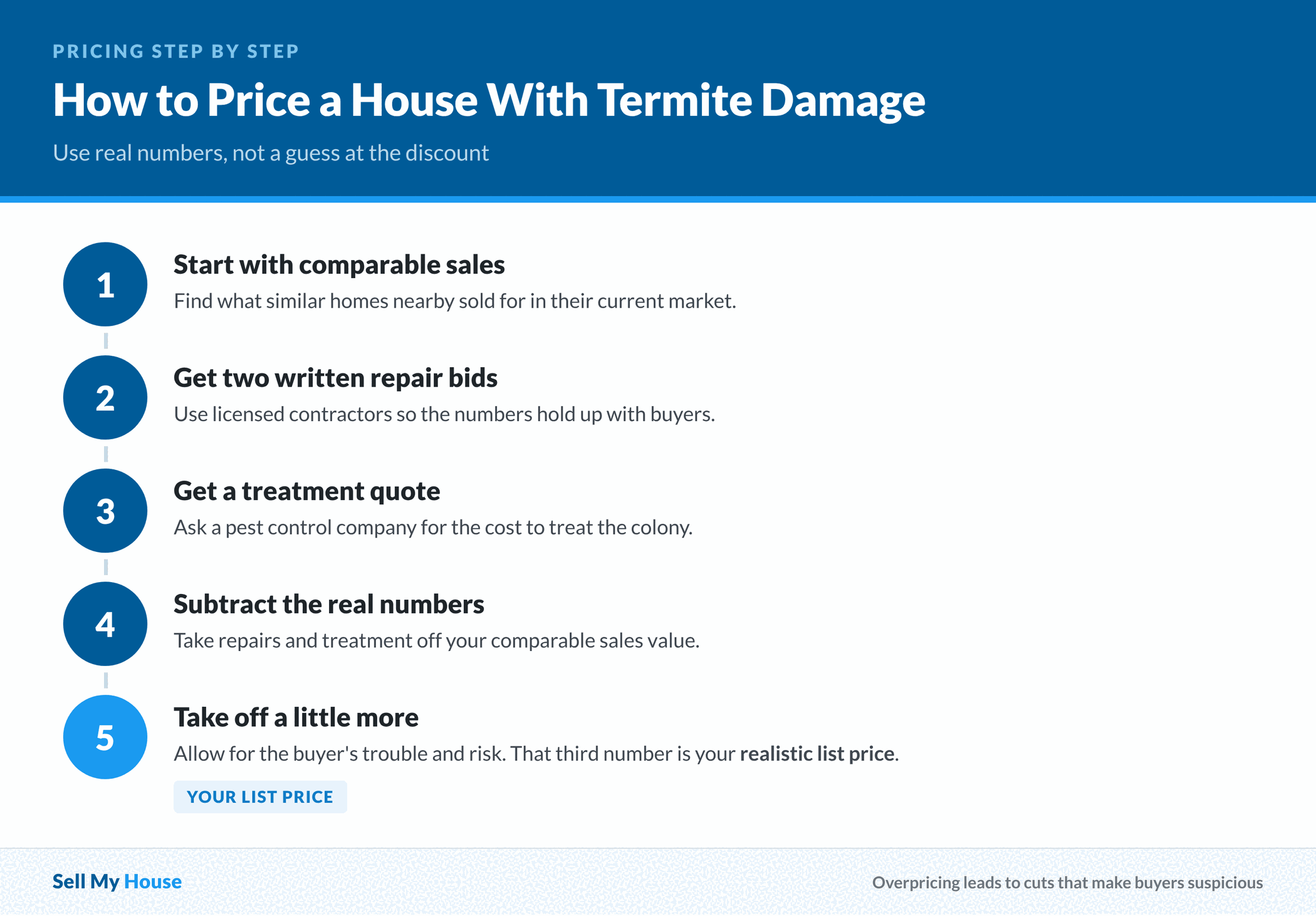
Pricing a house with termites comes down to which problem you’re asking the buyer to solve. Treated and repaired? Then you’re selling a house with a documented history, so price close to comparable homes and take a modest adjustment. If termites are still active and the wood is still chewed, you’re selling a project, and the price has to say so honestly.
Skip the guesswork on the discount. Get two written repair bids from licensed contractors and a treatment estimate from a pest control company. Subtract those real numbers from your comparable sales value, then take off a little more for the buyer’s trouble and risk. That third number is your realistic list price.
Overpricing is the expensive mistake. In October 2026, 20.5% of active listings nationally took a price cut during the month, and a termite-damaged house priced on hope will join them quickly. Every reduction tells buyers something’s wrong, and they go looking for termites.
Transferable warranties pay for themselves. A transferable warranty or prepaid inspections often cost less than the price concession a buyer would otherwise ask for. Many pest control programs include a termite bond that covers repair if the insects break through while coverage is active. That piece of paper negotiates harder for you than any paint job.
When repair bids climb past what you can float, selling directly to a buyer like Sell My House takes the repair question off the table.
Can You Sell a House with Termites to a Traditional Buyer?
Lose the financing and you lose the buyer, along with the earnest money timeline and six to eight weeks you won’t get back. That’s what happens when you bring an active infestation to a mortgage-dependent buyer without a plan.
Conventional lenders don’t always require pest inspections. Appraisers do flag visible wood-destroying insect damage, though, and underwriters react to it. Government-backed financing is stricter. FHA and VA files generally need documentation that active termites are gone and damaged structural wood is repaired before funds release.
You can still sell to a traditional buyer. It usually means finishing treatment before closing, completing or escrowing repairs, and giving your real estate agent documentation to hand over. Buyers paying cash have far more room to work, since no underwriter stands between them and the house.
Negotiations on these sales get sharp. Your buyer’s home inspector finds the damage, their agent asks for a credit, and suddenly you’re defending a number you didn’t pick. A pre-listing report pays for itself right there, because you set the terms up front rather than reacting to someone else’s findings.
Time is the other cost. Treatment scheduling, repair bids, contractor availability and a re-inspection can stretch a sale by a month or more. Realtor.com data put median days on market at 63 in October 2026. Tack four to six weeks of remediation onto the front end and you’re making a lot of mortgage payments on a house you’ve mentally already left.
What Are Your Options for Selling a Termite-infested House?
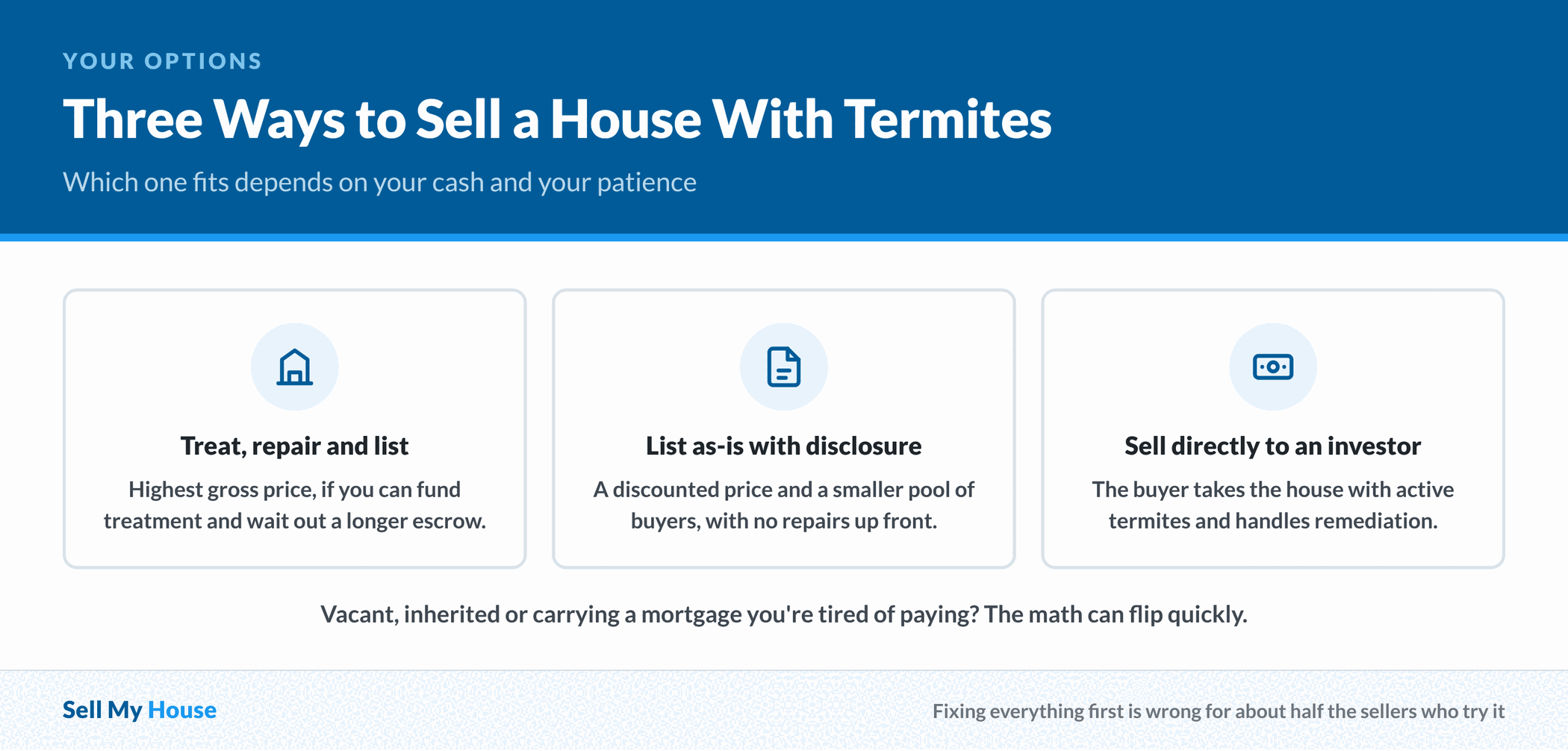
For maybe half the sellers who try it, fixing everything before listing is the wrong move.
Three realistic paths exist. One is to treat, repair and list traditionally for the highest gross price. Another is listing as-is with full disclosure at a discounted price, accepting a smaller buyer pool. The third is selling directly to an investor who buys houses with active termites and handles remediation on their own.
The right one depends on cash and patience. If you can float a few thousand in treatment and wait out a longer escrow, the traditional route nets more. The arithmetic flips fast, though, when the house is vacant, inherited or carrying a mortgage you’re tired of paying. Companies like Sell My House buy properties in exactly that condition, termites and all, without asking you to fund repairs first.
What would three more months of carrying the property cost you while contractors reschedule?
An owner mid-divorce reached out about a house neither spouse wanted to set foot in again. Termites had turned up in the back addition during a refinance attempt two years earlier, and nothing had been done since. Both of them just wanted one number and a closing date. We gave them that, and the attorneys split the proceeds without anyone fighting over a contractor bid.
Frequently Asked Questions
Is It Safe to Buy a House That’s Already Been Treated for Termites?
Usually, yes. A treated house with a clean re-inspection and a transferable bond is often a safer bet than an untreated house nobody has looked at. Ask for the treatment records and warranty paperwork. Also confirm that any damaged wood was repaired, not just painted over.
What Will It Cost Me to Treat Termites in a 2,000-square-foot Home?
For a home that size, a liquid barrier or bait system usually lands in the low thousands. Tent fumigation for drywood colonies runs higher, because it’s priced by square footage rather than foundation perimeter. Get at least two estimates, since pest control pricing varies widely by region, foundation type and species. Also ask whether annual monitoring is included or billed as its own line item.
Can I Get Rid of Termites Myself Without a Pest Control Company?
You can buy the same active ingredients the pros use, and DIY product costs run a fraction of a professional job. Application is the catch. Liquid barriers mean trenching the full foundation perimeter and drilling through slabs at precise intervals, and a gap anywhere in that line is an open door. Most buyers and lenders also want a licensed company’s report, so a self-treated house can stall at financing even when the work was solid.
Will Termite Damage Show Up on a Standard Home Inspection?
Often, though not always completely. General home inspectors flag visible signs such as mud tubes, damaged trim or soft wood, then recommend a specialist. A dedicated wood-destroying insect inspection digs further into crawlspaces, attics and sill plates. That’s the report a lender will want.
Does Homeowners Insurance Pay for Any of This?
No, and that catches people off guard more than anything else here. Standard policies exclude termite damage, because insurers treat it as preventable maintenance rather than a sudden loss. Every dollar of treatment and repair comes out of your pocket or your sale price.
If you’re sitting on a house with termites and can’t decide whether to treat it, discount it or just be done with it, we’re glad to talk it through. There’s no pressure, and we won’t judge what’s in the crawlspace.
Termite Houses and the Seattle Market
Seattle prices have cooled this fall. According to Redfin’s late October 2026 data, Seattle sale prices were down 5.1% from a year earlier, among the biggest drops of the large metros it tracks.
In a softer market, buyers have more room to push back on a pest report. If you’d rather skip the repair talks, you can sell the house as it sits. South of the city, we’re also cash home buyers in Tacoma. On the east side of the state, Spokane homeowners can sell to us the same way.
Get a Cash Offer on Your House With Termites
You can call us before treating the colony, fixing the wood or clearing out the crawlspace. Just tell us about the house and what the pest report says.
Reach out to Sell My House or fill out the short form below, and we’ll come back to you with a fair cash offer. It costs nothing, and there’s no obligation to sell.
Helpful Washington Blog Articles
- Can A Buyer Back Out After A Home Inspection In Washington
- How to Find a Realtor in Another State
- How Long Should You Live in a House Before Selling It
- Can You Sell a House With Asbestos in Washington
- How to Sell a House While Living in It
- Can Medical Bills Take Your House in Washington
- Cheapest Places to Live in Washington